
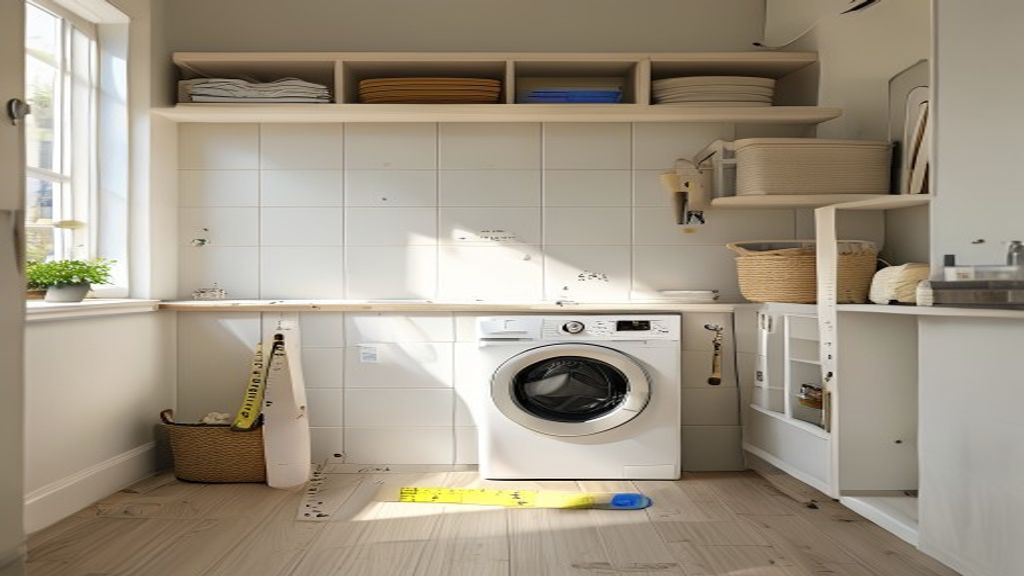
Before you compare stacked laundry machines, measure the room like an installer would: full depth, door swing, hookups, venting, clearance, floor level, and the awkward little spaces that decide whether delivery day goes smoothly.
A stackable washer and dryer can make a small laundry room feel much more usable, but only if the footprint actually works. The mistake is measuring the empty wall and stopping there. A stacked setup needs room for the machines, hoses, venting, door swing, leveling feet, vibration clearance, and the person who has to connect and service everything.
Use this as a pre-shopping checklist before you order a pair, book delivery, or assume a laundry closet is ready. The goal is not to choose a specific appliance here. It is to walk into that decision with numbers that match the room you actually have.
Quick Shopping Shortcuts
Disclosure: these are site-controlled shopping links. Everyday Edit may earn a commission where affiliate tracking is available, at no extra cost to you.
- Compact measuring tape — useful for checking alcove width, depth, height, and door clearance before ordering a machine.
- Washer-dryer anti-vibration pads — compare floor-protection options if vibration is a concern in a small room.
- Stacking kit compatibility research — start here, then confirm the exact kit against the appliance model numbers.
- Slim laundry-room shelf — a narrow storage add-on for detergent and dryer sheets when side clearance is limited.
Measure the full footprint, not just the width
Start with the three obvious numbers: width, depth, and height. Measure the narrowest point of the opening, not only the widest stretch of wall. Trim, baseboards, door frames, utility boxes, and uneven plaster can take away more space than you expect.
For width, measure at the floor, halfway up, and near the top of the alcove. For height, measure from the finished floor to the lowest obstruction, which might be a shelf, cabinet bottom, soffit, or ceiling light. For depth, measure from the back wall to the point where the front of the machines can realistically sit without blocking a doorway or hallway.
Write the numbers down in inches, then photograph the tape measure in place. Photos are useful when you are comparing installation specs later and cannot remember whether the depth included the door trim.
Add clearance for hoses, vents, and real doors
The published appliance depth is rarely the whole story. Most laundry setups need extra space behind the machine for water hoses, drain hose, electrical connection, gas line if relevant, and dryer venting. If the dryer is vented, the vent path can be the difference between a clean installation and a machine that sticks out several inches farther than planned.
Door swing matters too. Check whether the washer door, dryer door, room door, closet door, or nearby cabinet door can open without fighting the stacked unit. If the laundry area sits in a hallway, also check whether a basket can pass through while a door is open.
The safest habit is to measure the room with every nearby door open, then closed, then half-open. Small rooms often fail at the half-open stage because that is where people actually stand while loading laundry.
Check the hookups before you fall for a layout
A stacked setup only works if the hookups match the plan. Confirm where the hot and cold water valves are, where the drain sits, where the dryer vent exits, and whether the electrical outlet or gas connection is reachable without stretching anything awkwardly.
Do not assume the old machine footprint is enough. A previous side-by-side layout may leave valves, outlets, and venting in places that are inconvenient for a stacked pair. If the hookups are tucked behind a fixed shelf or tight corner, the room may technically fit the machines and still be miserable to install.
If you rent, photograph the hookups and ask before changing shelves, doors, venting, or plumbing. If you own, keep the installation sheet for the exact model pair in front of you before moving cabinets or ordering storage.
Look at the floor, not just the walls
Stacked laundry puts a lot of movement in one vertical column, so the floor deserves a quick check. Look for slopes, cracked tile, soft spots, old water damage, or a platform that was built for a different machine. A level floor matters for noise, vibration, draining, and long-term wear.
Anti-vibration pads can help with some floor feel, but they are not a fix for the wrong machine, a bad install, or a floor that needs repair. Treat them as a small comfort add-on, not as permission to ignore leveling instructions.
Also check the path from the door to the laundry area. A machine that fits the alcove still has to fit through stairs, hallways, turns, and doorways on delivery day.
Plan the storage around the stack
Once the machines are stacked, the room may lose the flat surface that a side-by-side setup used to provide. Decide where detergent, stain spray, dryer sheets, mesh bags, lint tools, and a small trash bin will live before the machines arrive.
A slim rolling shelf, wall shelf, or cabinet door organizer can help if the side clearance is limited. Keep storage shallow enough that it does not block the doors, valves, vent, or service access. In a very tight closet, one neat shelf above the machines is often better than several little organizers that make the room harder to use.
Leave enough space to wipe spills, clean the lint area, and reach shutoff valves quickly. Pretty storage is less useful than storage that lets you maintain the machines without emptying the whole closet.
The final pre-shopping checklist
Before you compare models, collect these numbers and photos: alcove width at three heights, usable depth with door clearance, ceiling or shelf height, hookup locations, vent path, outlet or gas connection, door swing, floor condition, delivery path, and any storage that cannot move.
Then check those numbers against the installation sheet for the exact washer, dryer, and stacking kit. Brand-specific stacking kits usually need to match the machine pair, so do not treat a universal-looking kit as automatically compatible.
A good stacked laundry setup should save space without making the room harder to use. If the measurements are tight, solve the clearance problem before ordering the machines. Delivery day is not the moment to discover that the door opens into the dryer or the vent needs three more inches than the room has.